The Paradise of Machines
Industrial Revolution, epistemology,
occult sciences, psychoanalysis, Modern Art
(1850-1960)


Robert Delaunay
Rythme, 1930
old machine circa 1930
Now in the Paradise of Machines
The idea of art applied to industry is simultaneous with the industrial revolution. In France, the School of Arts and Crafts was founded in 1780, the École Centrale des arts et manufactures in 1829, but it was really around 1850 and the Industrial Revolution that emerged the notion of art, which had to be integrated into the production of mass objects in order to facilitate their marketing. Thus was founded in 1864 at the Central Union of Fine Arts Applied to Industry;
The term Epistemology dates back to 1847 and belongs to the fields of study and philosophical approaches on the theory of knowledge. This means that from that time on, we began to study this field rationally and scientifically. there are different approaches to epistemology depending countries.
The expression "occult sciences" dates back 1829. Occultism operates by analogy and makes the spiritual connection with the material world through symbolic relations related to magic, esotericism, alchemy, etc. Occultism is a pseudo-science. In fact, this definition is very artistic.
At psychoanalysis level , the study of our inner world, of our psyché, we must cite Sigmund Freud (1856-1939) and Carl Gustav Jung (1875-1961) who instituted this discipline.
The story in which the factory product is promoted through marketing and advertising is also a matter of magic.
Occult means hidden, secret. If we want to tell a child to go somewhere, we tell him it is forbidden, hidden, secret: as soon as we say there is a secret, we send spies, and spying is one of the oldest jobs in the world.
So there is a relationship between machines, art, and esotericism that is part of the occult.
So in this painting by Hilma af Klint I see a keyhole painted to access luminous secrets.
Like the circles of Robert Delaunay are only gear covers on a metal lathe.
This does not take anything away from their genius to say what is beautiful, what feels true.

Finally, the beginning of modern art was established with Édouard Manet’s Lunch on the Grass in 1863; Monet liked to paint the atmosphere of London’s industrial smog, or lived at Phileas Fogg, who was allowed to travel around the world in 80 days by the Industrial Revolution; Phileas Fogg means 'who loves the fog ? no more and no less.
at the beginning of the second half of the 19th century on, a number of engineers were trained in schools of arts and crafts who contributed both to the design of many consumer objects of the art nouveau and then art deco movements. These objects are known by everyone and exhibited in dedicated museums.
they also designed a number of objects invisible to ordinary mortals because they belong to the purely hidden industrial world, into factories.
machines, boilers, gears, engines, turbines, and other purely utilitarian objects to which no attention is paid, such as Marcel Duchamp’s urinal fountain, which was created by an engineer for the sake of functionality, technical contingencies, and of aspect differentiation in relation to the competition’s offer.
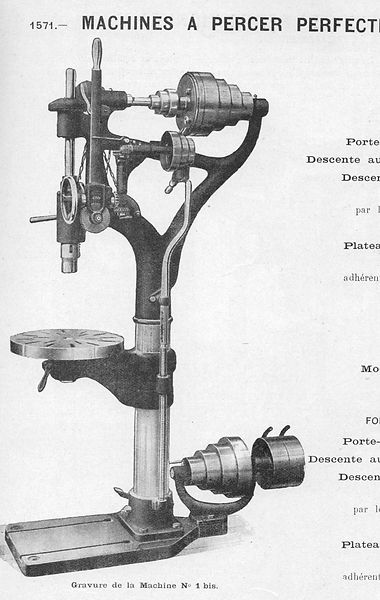
Thus, as we see the catalog "aux arts et métiers" from the Tampleu company dated 1926 and presenting various machines intended for making "beautiful", it is very clear that by its title, it was aimed to people in the mastery of technical knowledge from engineering schools bearing the same name as the book. Engineers who had to manufacture according to the state of the art and standards in their field. It is quite incredible to see that the machines were not shown in the form of photographs (whereas the technique already existed for the press). but in the form of hand-executed, signed illustrations by illustrious great talent unknown people, but nevertheless not in the style that characterizes geniuses.


This catalog is a document from an era and it was given to me by a neighbor in February 2026.
For the average person, it is impossible to imagine finding this; there are few of them in archives somewhere...
it features many illustrations of machines and attests to a true "art of the engineer"
art of the engineer which is generally used to characterize architectural works...
Nowadays, we see a personality of works that did not appear at the time...

Some machines from this catalog


I have found some


il est à noter que cette machine date de 1926 et que lorsque on considère ses deux oreilles, sa bouille ronde on ne pas s'empêcher de penser à Mickey, ce qui est normal, c'est l'esthétique d'une époque, Mickey date de 1928.
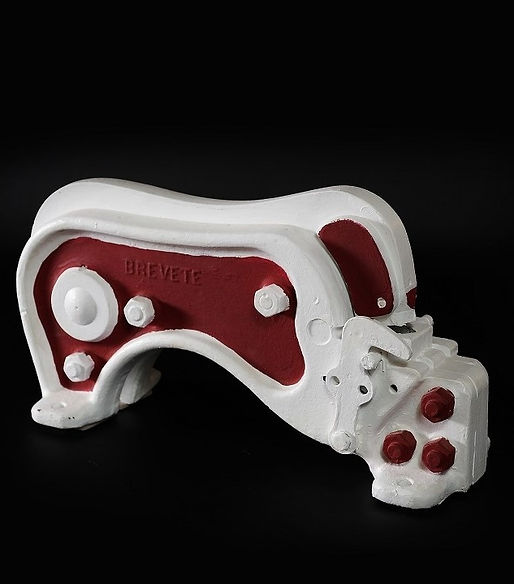




The industrial revolution world has been evoked many times by artists; in music, one immediately thinks of Arthur Honegger's Pacific 231, Charles Marie Widor's toccata, the ballets Prokofiev's Le Pas d'Acier and Shostakovich's Le Boulon; in painting, Claude Monet and the Gare St Lazare, then around 1920 by Robert Delaunay, Fernand Léger, Kupka and many others.